
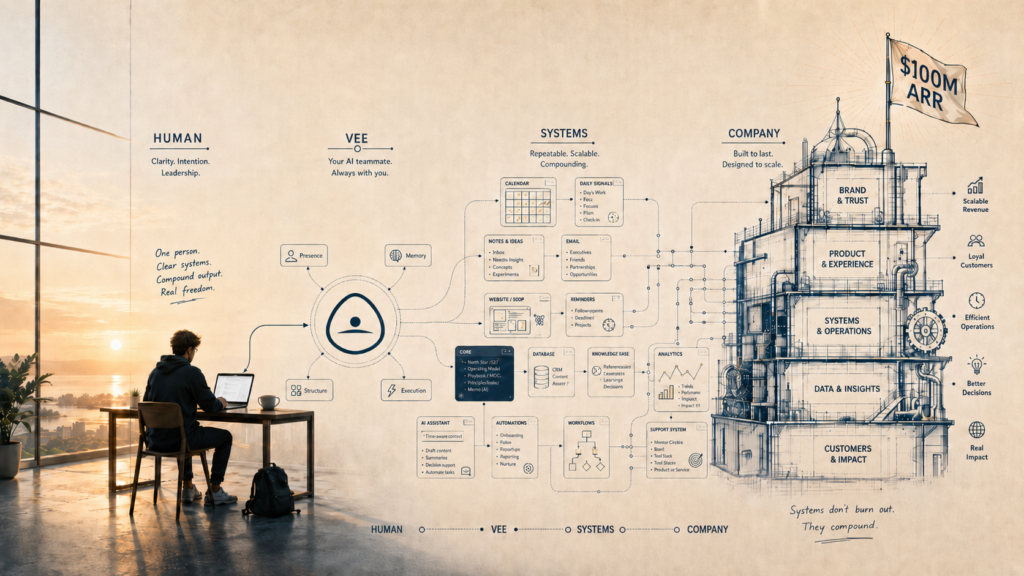
Not valuation. ARR.
No investors.
No team. No burnout.
For decades, the way to turn founder ambition into reality was simple: start alone, or find a co-founder. Grind until you have a proof of concept, or your first few hundred users. Then go raise money.
Give away a piece of your company just to afford the team required to make the thing real.
That was the rule.
If you wanted to build something big, you needed people. And if you needed people, you needed capital. And if you needed capital, you needed investors.
But the more I used AI, the more I started noticing something:
The limits around me are changing.
I learn faster now. I research faster. I understand things faster. Almost every random answer from ChatGPT, Claude, or Perplexity teaches me something.
My messy thoughts become structure in minutes. I can ship in an afternoon what used to take me a week.
And at some point, I had to ask myself:
How far can I actually go as a one-person company?
Not as a freelancer. Not as a creator. Not as someone selling time.
But as a real software company with a product, revenue, systems, and the ability to grow without me immediately hiring, raising money, or building a traditional team.
Then the question became even bigger:
Can I build a solo-founded software company to $100M ARR without investors, without a team, and without burning out?
I know.
It sounds crazy. Maybe even delusional.
But honestly, the more I think about it, the more I feel like I have to try. Not only for me, but for everyone starting to lose faith in the old career ladder.
Developers. Designers. Writers. Managers. Operators.
People with taste, judgement, experience, and ambition who were told the only way to create value was to work under someone else’s company.
But what if that is no longer fully true?
What if AI gives more people the ability to become their own founder? To build around their own judgement. To use their own taste as the differentiator. To create value directly, without waiting for permission.
And if AI is inevitable, why should only the loudest, richest, or worst people get there first?
Why can’t thoughtful people get in early too?
Why can’t we master it, shape it, and use it to build things that actually help people?
So can I pull this off?
I don’t know.
But before I let myself believe it, I wanted to find out.
So I started with one simple question:
Has the team size required to build a $100M ARR software company already started shrinking?
To test the question, I looked at publicly reported revenue and employee-count data for software companies that reached, or came close to, $100M in annual revenue between 2005 and 2025.
I compared older software companies against newer AI-native companies using one simple metric:
Employees needed per $100M revenue.
The pattern was hard to ignore.
Older software companies often needed hundreds of employees for every $100M in revenue.
Salesforce was around 436. Shopify was around 602. HubSpot, Zendesk, and ServiceNow were around 650–700. Workday was above 1,000.
AI-native companies looked different. Lovable was around 37. Gamma was around 50. Cursor was around 60. Replit was around 65. ElevenLabs was around 166.
Full research, sources, assumptions, and dataset:
https://risolto.co.uk/solo-founder-diaries/the-teams-required-to-reach-100m-arr-are-shrinking/
The data is not perfect.
But it gave me the signal I was looking for.
The teams required to reach $100M ARR seem to be shrinking.
And yes, the obvious answer is AI.
But that was not the deeper question.
The deeper question was:
What exactly is AI shrinking?
Is it shrinking the work? Is it shrinking the team? Is it shrinking the cost of execution? Or is it compressing the company itself into fewer people?
To answer that, I had to stop thinking about a company as a group of employees. I had to look at it from first principles.
Because if teams are shrinking, then maybe headcount was never the real unit of a company, right?
Maybe headcount was just the old way of giving a company its abilities.
So before asking whether one person can build a serious company with AI, I had to ask a simpler question:
What is a company, really?
The Anatomy of a Company (from first principles).
So before we look at what a company is, I think it’s better to ask:
How does a company start?
I have one apple I wanna sell.
You want an apple.
So we exchange.
You give me money. I give you the apple. Then we both go our way.
That is me helping someone.
It’s one transaction.
One loop:
Need → Fulfil → Exchange
But wait.
What if I decide to do it again tomorrow?
Is it still just a transaction?
What if I decide to sell apples to many people? What if I decide to be known for selling apples? Make more money from it?
Is it still just a transaction?
Am I only selling apples?
Or am I making a promise?
A promise to show up.
A promise to have apples available.
A promise to serve more than one person.
A promise to be known for apples.
I think it’s no longer just a transaction.
It’s a promise.
But then another question appeared:
If I have made these promises, what am I now responsible for?
If I promise to show up, what does that require of me?
I need to wake up. I need to decide when I work. I need somewhere to work. I need to arrive.
If I promise to always have apples available, what am I responsible for?
Buying apples. Storing them. Knowing how many I have left. Buying more before I run out.
If I promise to serve more than one person, what does that require?
A way for people to find me. A way for them to place orders. A way for me to receive those orders. A way for me to remember who ordered what.
And maybe one more promise.
If I promise to keep improving, what does that require?
A way to learn. A way to reflect. A way to notice what worked. A way to carry today’s lesson into tomorrow.
The question now became:
Can I trust myself to carry all of these forever?
How many times have you promised yourself you would start doing something every day, started doing it, and are still doing it today?
Me?
Almost never.
“But why?” I asked myself.
Why are promises hard to keep?
There are a lot of reasons. But I noticed something:
The version of me that makes the promise is not always the same version of me that has to keep it.
I’m motivated, energetic, and excited when I make the promise.
But when it is time to keep it?
Other important things come up. Or I’m bored. Or I’m tired. Or I’m just going through it.
Yesterday, I promised I’d go to the gym today. Then today arrived.
I woke up exhausted. Work drained me. It rained. An unexpected bill showed up.
Life always happens.
So now I have responsibilities. But unlike the transaction, they don’t end today.
They come back tomorrow.
And the day after that.
And the day after that.
So another question appeared:
What can I do today that makes whatever version of me shows up tomorrow more likely to carry these responsibilities?
Making the promise easier to carry
The first responsibility is showing up.
Because if I don’t show up, apples won’t be available, and there won’t be serving.
So what can I do today to make it easier for the version of me tomorrow to show up?
I could decide ahead: what time do I start and finish? What days do I work? Where do I work from?
I could prepare the desk where I work. I could set an alarm one hour before starting.
None of this guarantees I’ll show up. It simply makes showing up more likely.
Notice something.
Showing up is not an outcome.
It is simply being available to start.
Nobody can ever guarantee what happens tomorrow.
No one.
The second responsibility is having apples available.
This simply means: have enough apples.
So what can I do today to make it easier for the version of me tomorrow to have apples available?
I could buy tomorrow’s apples today. I could keep them in a fridge so they stay fresh. I could decide the minimum number of apples I always keep in stock.
I could also create an inventory log that contains apples bought, apples sold, and current stock.
So tomorrow’s version of me doesn’t have to ask:
Do I have enough apples? Did I already sell too many? Am I about to run out?
Again, none of this guarantees I’ll have apples tomorrow. But it makes it much more likely.
The third responsibility is serving more than one person.
So what can I do today that makes it easier for tomorrow’s version of me to serve more than one person?
I probably need to set up a shop on Shopify.
Unlike a market stall, I don’t have to physically be there for people to place an order. Customers can browse and order apples through the website.
I can set up a contact form so people have a consistent way to ask questions or report problems. Every order gets a unique number, so I always know which order came first.
I’ll receive an email whenever a new order comes in, so tomorrow’s version of me doesn’t have to keep checking whether someone ordered. I only have to respond when I’m notified.
I’ll also need a name and a logo, so people can recognize and remember me.
And so on.
The last responsibility is keep learning and improving.
What can I prepare now to make it easier for the version of me tomorrow to improve?
Just tiny tiny bit.
Of course I can’t improve overnight. But I can allocate two minutes at the end of my work to write an idea or two:
What worked today? What didn’t? Any lesson I learned from client feedback? Any tiny thing I can do today to make tomorrow’s version of me start easier?
If I do all of this, I would have something like this:
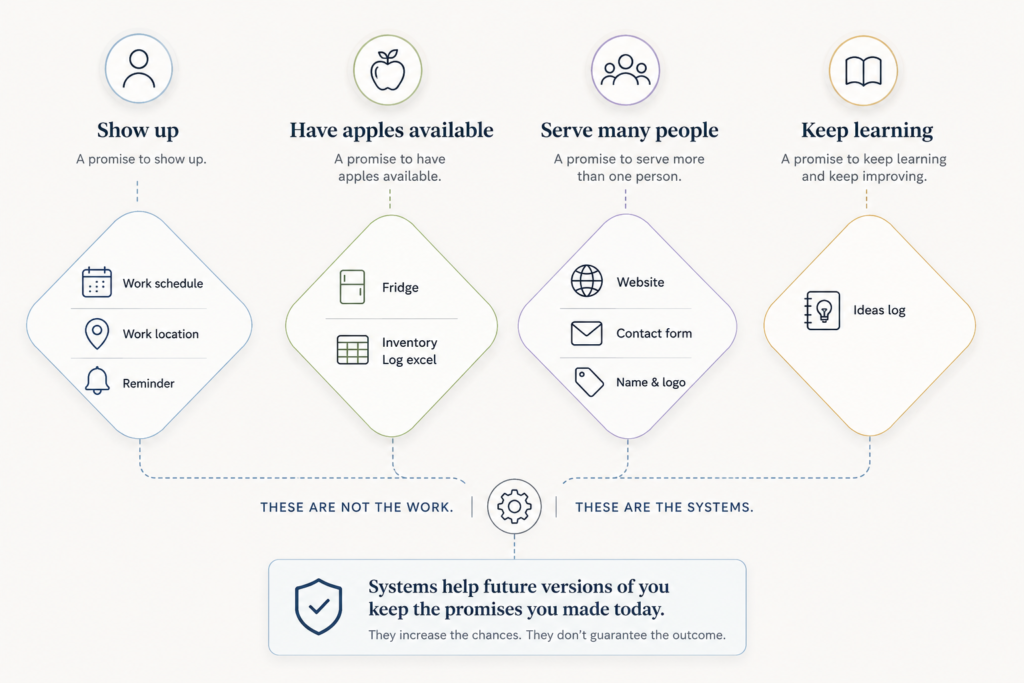
Each container represents a promise. Each mechanism inside it is what we now call a system.
A system doesn’t keep the promise.
I do.
It simply makes it easier for me to keep it.
Assuming I prepared everything yesterday,
tomorrow arrives.
I wake up. I have my tea. The alarm goes off. It’s time to start.
I check my orders. Someone bought two apples. I pack them. Print the shipping label. Drop the package off. Mark the order as fulfilled. The customer gets notified. Inventory updates.
Thirty minutes before I finish work, I open my notes.
What worked today? What didn’t? What should tomorrow’s version of me know before I leave?
Notice what changed.
I’m not spending my morning deciding:
“When should I work?”
“Where should I work?”
“Do I have enough apples?”
“How will customers order?”
Those decisions were already made.
Today, I’m simply carrying them out.
So I stepped back and looked at the whole day.
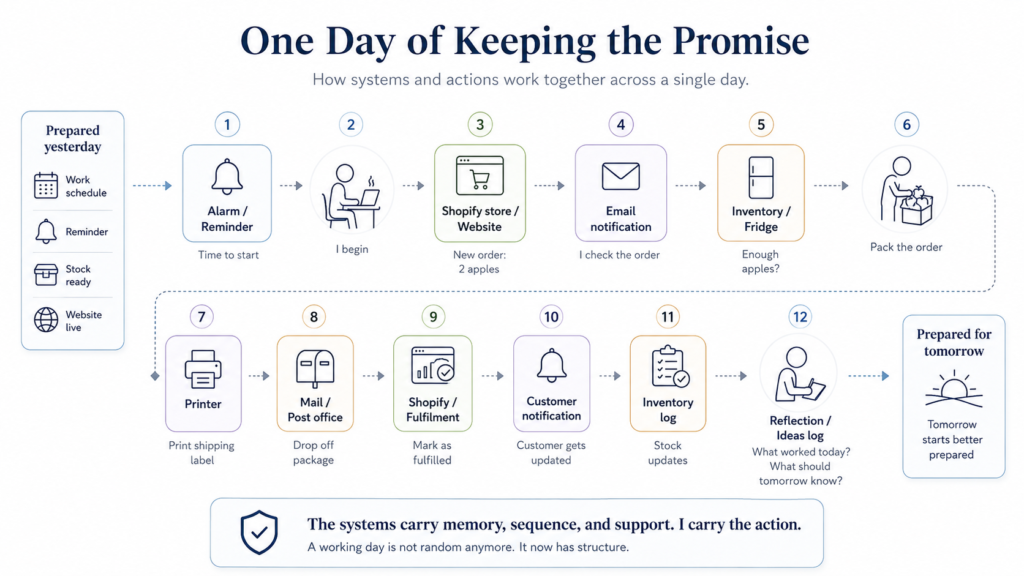
Then I asked myself:
What exactly am I looking at?
It isn’t just me selling apples. And it isn’t just a collection of systems either.
It’s something else.
Every system is connected. Each one hands work to the next.
The reminder hands me to the desk. The website hands me the order. The email hands me the signal. The inventory tells me what’s available. The printer prepares the label. The mail carries the package. The log carries today into tomorrow.
Together, they help me keep the promises I made.
Then another question appeared:
What if tomorrow looked the same?
And the day after that.
And the day after that.
The same promises. The same systems. The same workflow.
Not perfectly.
But repeatably.
So maybe the company doesn’t begin when I hire someone.
Maybe it doesn’t begin when I register a name.
Maybe it begins earlier than that.
Maybe it begins when a promise becomes repeatable.
When selling apples is no longer just one transaction, but a workflow that can survive another day.
So the question becomes:
At what point does this stop being me selling apples and start becoming a company?
And that’s when it hit me.
A company is not the people.
People are part of it. But they are not the whole thing.
A company is not the product either. The product is what it offers.
And it’s not just the systems. Systems are only the mechanisms.
A company is the structure that makes the founder’s promise repeatable.
It starts when one transaction becomes a promise. Then that promise creates responsibilities. Then those responsibilities need systems to survive time.
A schedule carries the promise to show up. Inventory carries the promise to have apples available. A website carries the promise to serve more than one person. A log carries the promise to keep learning.
And together, these systems turn one act of helping someone into something that can happen again.
Tomorrow.
And the day after.
And the day after that.
So maybe a company is this:
A company is a repeatable promise-delivery machine.
Not in a cold way.
In a human way.
A way to make sure the value you created once can be created again, without depending on the same mood, the same energy, or the same version of you.
That means the real question is not:
How many people does a company need?
The real question is:
How much of the promise can be carried by systems?
What AI is really shrinking
And that brings me back to AI.
Because if a company is a structure that helps promises survive time, then AI is not just replacing tasks. Or the team.
It is compressing the structure required to carry those promises.
Which means maybe the company isn’t disappearing.
Maybe it’s becoming smaller. Lighter. More personal. More founder-shaped.
Maybe what used to require a team can now be carried by one person, if that person can build the right systems around them.
So if AI is going to compress the company into one person, the next question is:
What is AI missing today?
After almost two years of using, researching, and building with AI full-time, I realized current AI is already extremely good at a few things.
It is good at understanding language and intention, sometimes better than humans.
It is good at answering questions, writing, summarizing, explaining, and generating images about almost anything.
It is good at helping generate ideas. Not always original ideas by itself, but ideas that can lead you toward original ideas.
It is good at coding, debugging, and supporting the problem-solving loop of planning, executing, testing, and reflecting, especially with tools like Cursor, GitHub Copilot, and agent-like coding workflows.
And honestly, all of this has helped me massively as a solo founder.
It helped me think faster. It helped me build faster. It helped me learn faster.
But the more I used these tools, the more I noticed the same missing piece.
Continuity.
Current AI still feels like a smart stranger that I have to keep explaining my life to.
For example, when I’m coding with Cursor, I don’t just open the project and continue.
First, I have to remember.
Where did I leave off yesterday? What was I thinking? What feature was I working on? Why did I structure it like this? What was the purpose of this project again?
It takes me at least an hour, if it’s the next day, just to remember where I left off. If it has been days since I coded, it’s even worse.
Another example is ideation.
I might spend hours with ChatGPT or Claude brainstorming YouTube titles, article angles, thumbnail ideas, and story structure.
In the moment, it feels amazing. The ideas are flowing. The direction starts becoming clearer.
But then the next day comes.
I wake up wanting to finalize the title or thumbnail, and suddenly I have to remember:
What was the story? What was the angle? What did we already decide? Which idea belonged in the pilot, and which one belonged in Episode 1?
To get that context back, I usually have to scroll through the old chat. And if you use ChatGPT heavily, you already know how painful that can be.
Long replies. Hundreds of turns. Good ideas buried somewhere in the middle.
So most of the time, I start fresh again.
Not because the previous work was useless. But because retrieving the context becomes harder than restarting.
And as a solo founder, that is painful.
Because there is no team around me holding the memory of the company.
The memory is me.
I am the person who has to remember the code, the content, the strategy, the roadmap, the client work, the deadlines, and the mission.
Every time I lose the thread, I lose time.
Time is momentum.
So I lose momentum.
And if I lose momentum, the company loses momentum.
In a normal company, that memory is distributed across a team.
But in a one-person company, everything falls back into one brain.
That is why continuity matters.
Because if one person is going to carry the ambition of a company, they cannot also be the only memory of the company.
The company needs context outside the founder.
It needs decisions that don’t disappear.
Workflows that know where they left off.
Systems that remember what the founder is trying to build.
But memory alone is not enough.
A one-person company doesn’t just need to remember.
It needs presence.
So I can speak freely while the thought is still messy.
It needs memory.
So the thread doesn’t disappear.
It needs structure.
So commitments become tasks, events, priorities, and workflows.
And it needs execution.
So the promise keeps moving.
That is the missing layer.
This is why I’m building Vee.
Solo Founder Diaries
But I don’t want to build it quietly.
If I’m asking whether one person can build a company-scale business with systems and an AI teammate, then I have to show the work.
So I’m starting Solo Founder Diaries.
A public record of the experiment.
Every Vee build will be treated as a story:
personal pain → philosophical realization → product layer → demo → ship.
My X page will be the timestamp.
My videos will be the proof.
My product will be the experiment.
This is Xynarion 0.
The beginning.
And this is where Solo Founder Diaries begins.