Seeing AI companies like Cursor, Replit, and Gamma reportedly reach $100M ARR with surprisingly small teams made me wonder:
Is this actually new?
Are AI companies doing something software companies could not do before?
Or have small teams always been able to reach $100M ARR.
And we are only noticing it now?
To find out, I looked at publicly reported ARR and employee-count data for software companies that reached $100M ARR between 2005 and 2025.
The question was simple:
“Are the teams required to reach $100M ARR getting smaller?”
To answer the question,
I couldn’t just look at today’s AI companies.
If I only looked at Cursor, Replit, Gamma, Lovable, and ElevenLabs,
the conclusion would be too easy:
“AI companies are more efficient.”
But that would not prove much.
I needed to compare them against earlier software companies too.
So I started collecting publicly available data,
on software companies that reached,
or came close to, major revenue milestones around $100M.
For each company, I looked for two things:
- How much revenue the company reported
- How many employees it had around that same period
Then I separated the evidence into two layers.
The first layer was a watchlist.
This included interesting companies,
and claims I wanted to investigate, but not automatically trust.
The second layer was source evidence.
This is where I checked the actual sources behind each claim:
public filings, company blogs, founder statements,
reputable media reports, investor research, and secondary sources.
I gave stronger weight to public filings and company statements.
I treated private-company ARR claims more carefully,
because they are usually not audited publicly.
I also separated ARR, annual revenue, annualized revenue,
and run-rate revenue, because they are not the same thing.
Then I used one main metric:
Employees Needed per $100M Revenue.
The formula is simple:
Employees divided by revenue, then multiplied by 100.
So if a company had 500 employees and $100M in revenue, it needed 500 employees per $100M revenue.
If another company had 50 employees and $100M in revenue, it needed only 50 employees per $100M revenue.
That is the number I cared about.
Not because it tells the whole story.
But because it makes the pattern easier to see.
The lower the number, the fewer employees the company needed to generate $100M of revenue.
After that, I marked each company as:
Yes, strong enough for the core chart.
Caution, interesting, but the source or date match is weaker.
No, not strong enough to use in the main analysis.
The goal was not to make the data look perfect.
The goal was to avoid fake precision.
Private-company revenue data is messy.
Employee counts are not always reported at the exact same time as revenue milestones.
Some companies use contractors.
Some claims are media-reported.
Some are annualized.
So I did not treat every row equally.
I wanted to see whether the pattern was still visible even after separating stronger evidence from weaker evidence.
And that is where the story became interesting.
The Data
“I also made the full dataset public so anyone can check the sources,
Assumptions and caveats behind the numbers.
The table below is simplified on purpose,
But the full sheet includes the revenue source,
employee-count source, source confidence, notes,
You can view the full dataset here: Public Google Sheet”
| Company | Revenue | Employees | Employees Needed per $100M Revenue |
|---|---|---|---|
|
Salesforce |
$176.0M |
767 |
435.8 |
|
ServiceNow |
$92.6M |
603 |
650.9 |
|
Workday |
$134.0M |
1,452 |
1,083.6 |
|
HubSpot |
$102.6M |
719 |
700.8 |
|
Zendesk |
$72.0M |
473 |
656.9 |
|
Shopify |
$105.0M |
632 |
601.9 |
|
Slack |
$105.2M |
385 |
366.1 |
|
Lovable |
$400.0M |
146 |
36.5 |
|
Gamma |
$100.0M |
50 |
50.0 |
|
ElevenLabs |
$200.0M |
331 |
165.5 |
|
Cursor / Anysphere |
$500.0M |
300 |
60.0 |
|
Replit |
$100.0M |
65 |
65.0 |
Note: Revenue basis differs by company. Older public companies mostly use annual revenue from filings. AI-native companies mostly use reported ARR. Full sources and caveats are available in the public dataset.
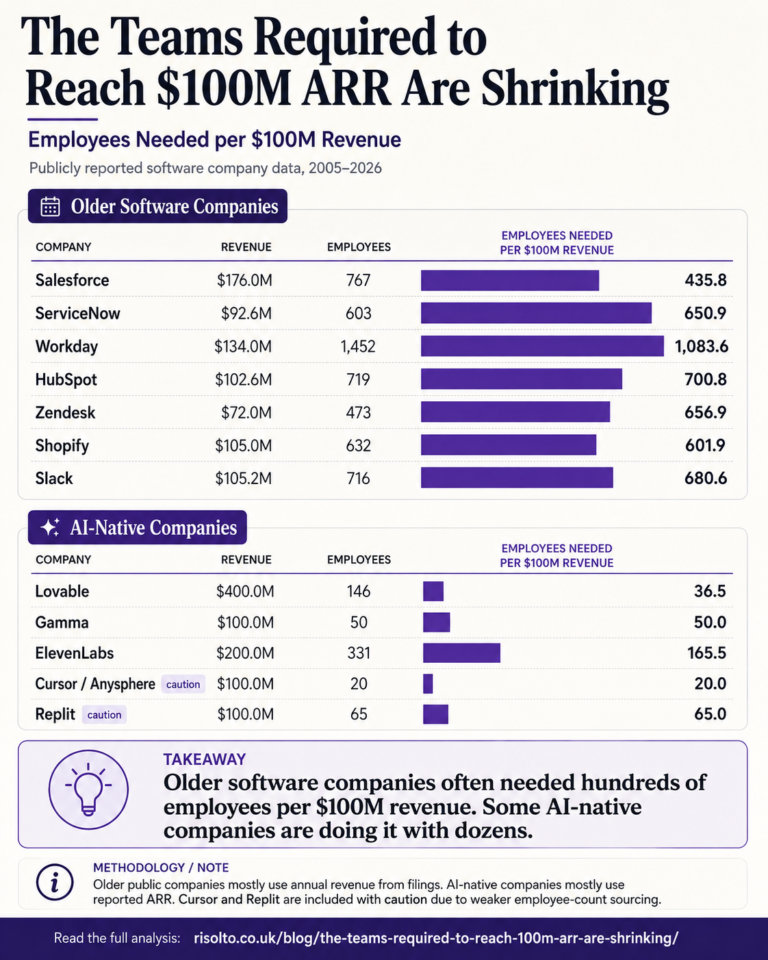
This is where the pattern starts to show.
The older software companies in this dataset often needed hundreds of employees,
for every $100M of revenue.
Salesforce needed around 436.
Shopify needed around 602.
ServiceNow, Zendesk, and HubSpot were around 650–700.
Workday was above 1,000.
Then the AI-native companies look different.
Lovable needed around 37 employees per $100M revenue.
Gamma needed 50.
Cursor needed around 60.
Replit needed around 65.
ElevenLabs needed around 166.
Even if we treat Cursor and Replit with caution,
because their employee-count sourcing is weaker,
the direction is hard to ignore:
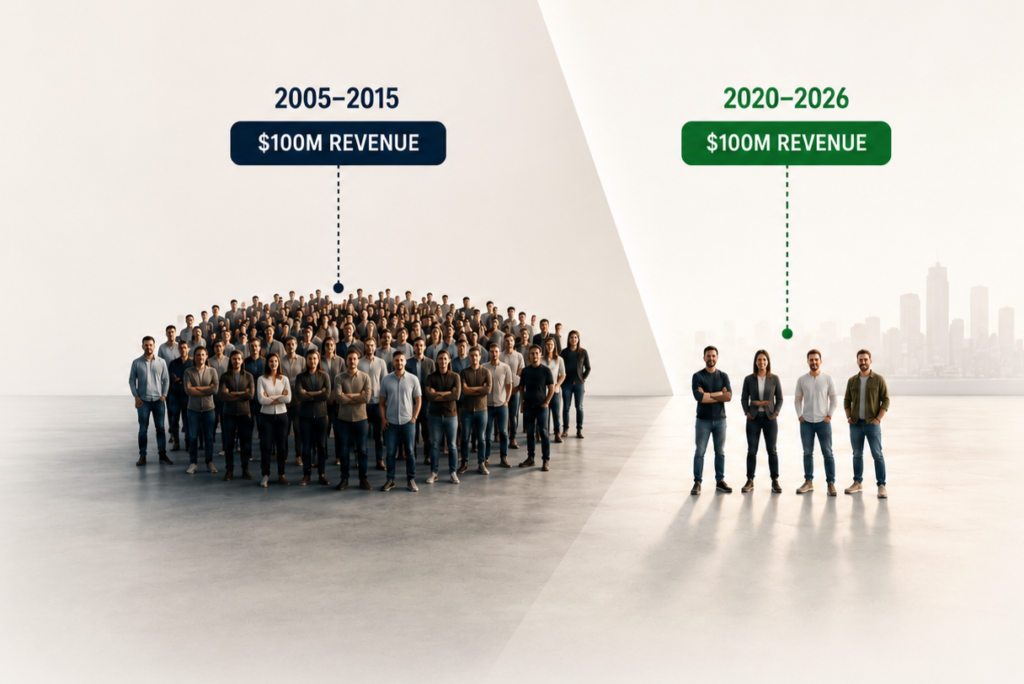
The old software companies often needed hundreds of employees per $100M in revenue.
Some AI-native companies are doing it with dozens.
Here is an inforgraph you can take: